
A POS workstation is a physical terminal that finalizes sales transactions in retail or hospitality environments. This guide covers how to select, deploy, and maintain POS workstations for multi-location businesses, with a focus on hardware, integration, and rollout best practices. It is intended for IT managers, system integrators, and retail operations leaders who are responsible for ensuring reliable, scalable, and supportable checkout solutions. Choosing the right POS workstation can reduce rollout risk, lower support costs, and improve customer experience across all your locations.
If you’re searching for a POS workstation, you’re probably not looking for “a touchscreen.” You’re looking for a checkout station you can deploy repeatedly, support under pressure, and keep consistent across locations. A deployable POS workstation is the combination of the core terminal, the peripheral stack (printer, scanner, cash drawer, customer display), the ports/cabling/power plan, and a supportable lifecycle model (staging, spares, RMA, and version control). Modern POS workstation technology acts as a central hub for business operations, offering benefits such as cloud-based, mobile-friendly deployment and management that go far beyond traditional cash registers.
Before you compare models, make three decisions that reduce rollout risk:
- Standardize the workstation outcome, not just the terminal (define the full bill of materials and cable plan).
- Choose your integration boundaries (especially payment: standalone vs semi-integrated vs integrated).
- Design for serviceability (swap model, spares pool, and a repeatable acceptance test per site).
POS workstation solutions are tailored for different industries, and the right technology choice can maximize benefits for each business type.
If your next step is to map your options to real hardware categories, start from the POSZEO products catalog and treat every workstation decision as a deployment system—not a single device.
What a POS workstation is (and what it isn’t)
A POS workstation is a physical terminal that finalizes sales transactions in retail or hospitality environments. A POS workstation is a complete checkout station designed to process transactions reliably at a fixed point of sale—usually a counter or checkout lane. POS workstations are used across various industries, including retail, restaurants, and service-based businesses, with specific features and benefits tailored to each industry’s operational needs.
For B2B buyers, “workstation” implies more than a terminal:
- A predictable hardware bundle (compute + display + peripherals)
- Enough ports and power to avoid adapter chains
- A defined mounting and cable-routing approach
- A plan for staging, support, and spares
Workstation vs POS terminal vs POS system (scope control)
These terms get mixed up in procurement conversations:
- POS terminal: the main computer + display device (Android/Windows/Linux) used by staff.
- POS system: the broader solution—software, payments, back office, and reporting.
- POS workstation system: the “deployable outcome” at the counter—terminal plus peripherals, connectivity, and supportability. A modern POS workstation system often comes as a suite of integrated hardware and accessories, including a touchscreen or device to ring up sales, payment processing, and POS software for managing inventory and sales.
If you’re quoting, deploying, or supporting multiple sites, you want to spec a POS workstation system—because that’s what you will install, troubleshoot, and replace at 8:30 pm on a Saturday.
The minimum POS workstation stack (hardware BOM thinking)
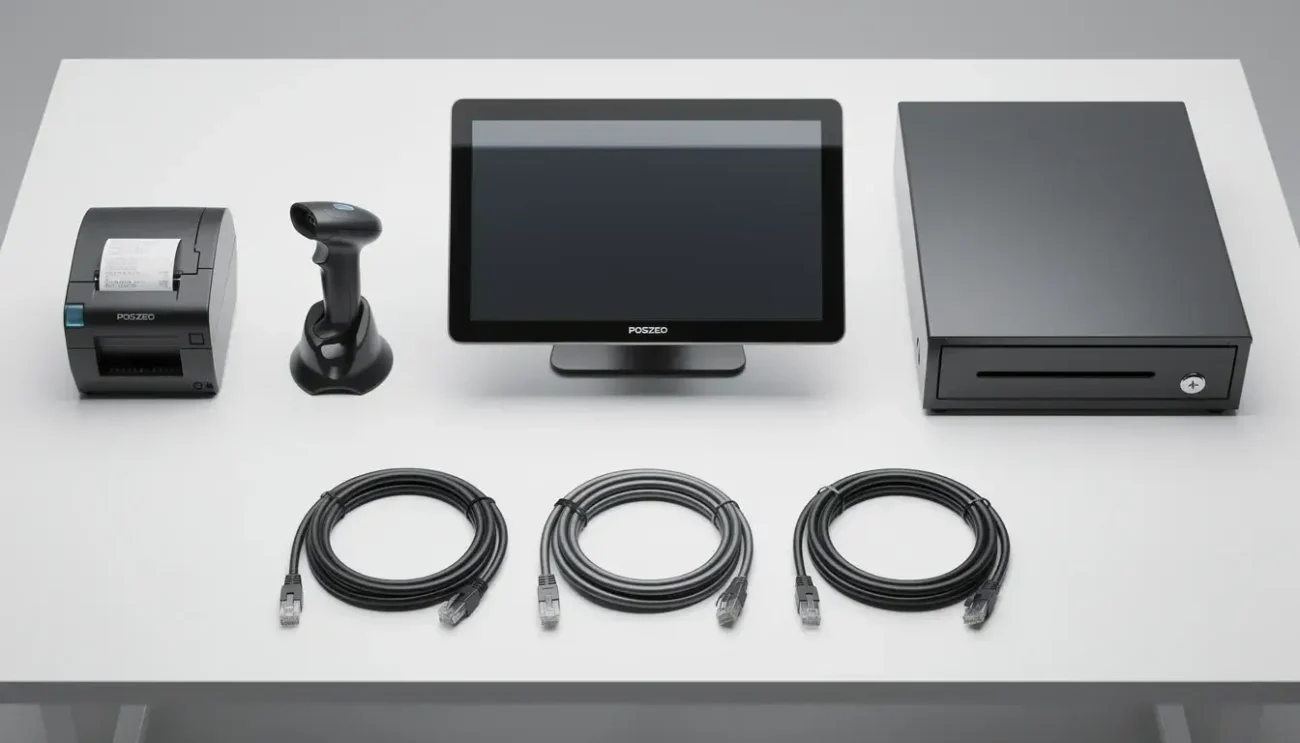
A workstation that “works in a demo” can still fail in the field if the bundle isn’t complete. Use a BOM mindset from day one.
Leading POS workstation models, such as the Workstation 6 Series, stand out by offering a full suite of key features designed for quality, durability, and reliability. The Workstation 6 Series combines a stylish, modern design with the industry’s most durable, embedded components, ensuring industry-leading reliability and extending hardware life. Its suite of optional integrated accessories includes a fingerprint reader, soundbar with proximity sensor, enhanced audio speakers, and a traditional MSR, providing a comprehensive solution for any business environment.
Core components
- Terminal / compute
- Touchscreen POS terminal, all-in-one, or compact desktop + separate monitor
- OS selection: Windows or Android for most deployments; Linux in specific stacks
- Performance headroom: don’t spec to “today’s UI only”—spec for plugins, reporting, and peak operations
Mounting/ergonomics
- Stand, pole mount, VESA mount, or counter base
- Cable strain relief and service loop (so technicians can service without unplugging everything)
Peripheral stack
- Receipt printer (58mm or 80mm, USB/LAN, cutter durability)
- Barcode scanner (1D/2D, presentation or handheld, mode configuration; essential for streamlining checkout and compatible with USB, Ethernet, Bluetooth, and Wi-Fi)
- Cash drawer (drawer trigger method compatibility; essential for secure cash management and integrated with POS via USB, Ethernet, Bluetooth, or Wi-Fi to ensure reliable transaction workflows)
- Customer display (optional but common in retail transparency and upsell workflows; dedicated customer displays enhance the checkout experience and improve customer engagement)
These peripherals, combined with touchscreens, enable faster checkout and significantly decrease transaction times by facilitating efficient barcode scanning and seamless customer interaction.
Connectivity and power
- Ethernet preferred for fixed lanes, Wi-Fi as a secondary path
- Power budget: terminal + printer + payment device + display
- Surge protection and cable management
Why “mix-and-match” becomes expensive at scale
Mix-and-match often creates silent risk:
- The printer triggers the cash drawer differently across stores
- A scanner defaults to the wrong mode after a reset
- A USB hub becomes a single point of failure
- OS updates change drivers and break peripheral behavior
Inconsistent hardware not only increases downtime and support complexity but also raises replacement costs and overall costs, making maintenance and device replacement more expensive compared to standardized solutions.
If you want a repeatable path, build your workstation around a known desktop category, such as desktop POS systems, and lock down the peripheral variants you’ll support.
Form factors: countertop, dual-screen, keyboard workstation, and hybrid lanes
A POS workstation is not one shape. Choose form factor based on throughput, counter space, and operational discipline.
Modern POS workstations often feature a compact design, optimizing storage and space utilization, especially in environments where counter space is at a premium. Many Android POS workstations are specifically designed to be compact, helping businesses maximize efficiency and maintain a modern, streamlined appearance while offering flexible device storage options.
All-in-one touchscreen POS workstation (most common)
Best for: boutiques, mid-traffic retail, service counters
Why it works: fewer parts, cleaner install, less cabling. All-in-one touchscreens feature an intuitive interface, allowing POS terminals to be set up quickly and used easily with minimal training for staff.
What to verify:
- Port count (don’t assume “USB ×4 is enough”)
- Network (wired LAN available?)
- Stand stability and cable routing
Dual-screen checkout workstation (operator + customer)
Best for: retail lanes that benefit from transparency, loyalty prompts, or customer confirmation
Trade-offs: more power and cabling, more mounting constraints, more replacement SKUs
Dual-screen workstations allow users to interact with both the operator and customer displays, enhancing engagement and streamlining workflows. The use of multiple displays, including dedicated customer displays, improves the checkout experience and customer engagement. High-quality displays, such as the Workstation 6’s expansive 15.6-inch widescreen HD display with 500 nit brightness and anti-glare coating, further improve visibility and user experience. Dual-screen can reduce disputes (“I didn’t buy that”) and speed up payment handoff, but only if your cable plan is standardized.
Keyboard POS cash register workstation (high-speed lookup workflows)
A POS cash register workstation typically combines a touch UI with a physical keyboard and often integrates a cash drawer and printer into one station.
Best for: supermarkets, high-SKU environments, coupon-heavy workflows, and businesses where inventory and stock management are critical, and where quick access to menu items or products is needed.
Why it works: tactile keys for fast PLU lookup, supervisor overrides, training consistency, and efficient management of inventory, stock, and menu items for seamless sales operations.
If you want a concrete reference for this style of station, see a workstation example like the DK-QD16 POS cash register workstation and translate it into your own “standard lane BOM” (terminal + peripherals + mounting + spares plan).
Note: Many POS workstations now feature automated inventory management, including real-time stock updates with each sale, low-stock alerts, and the ability to generate purchase orders automatically to prevent out-of-stock scenarios.
Hybrid lanes (workstations + handhelds + kiosks)
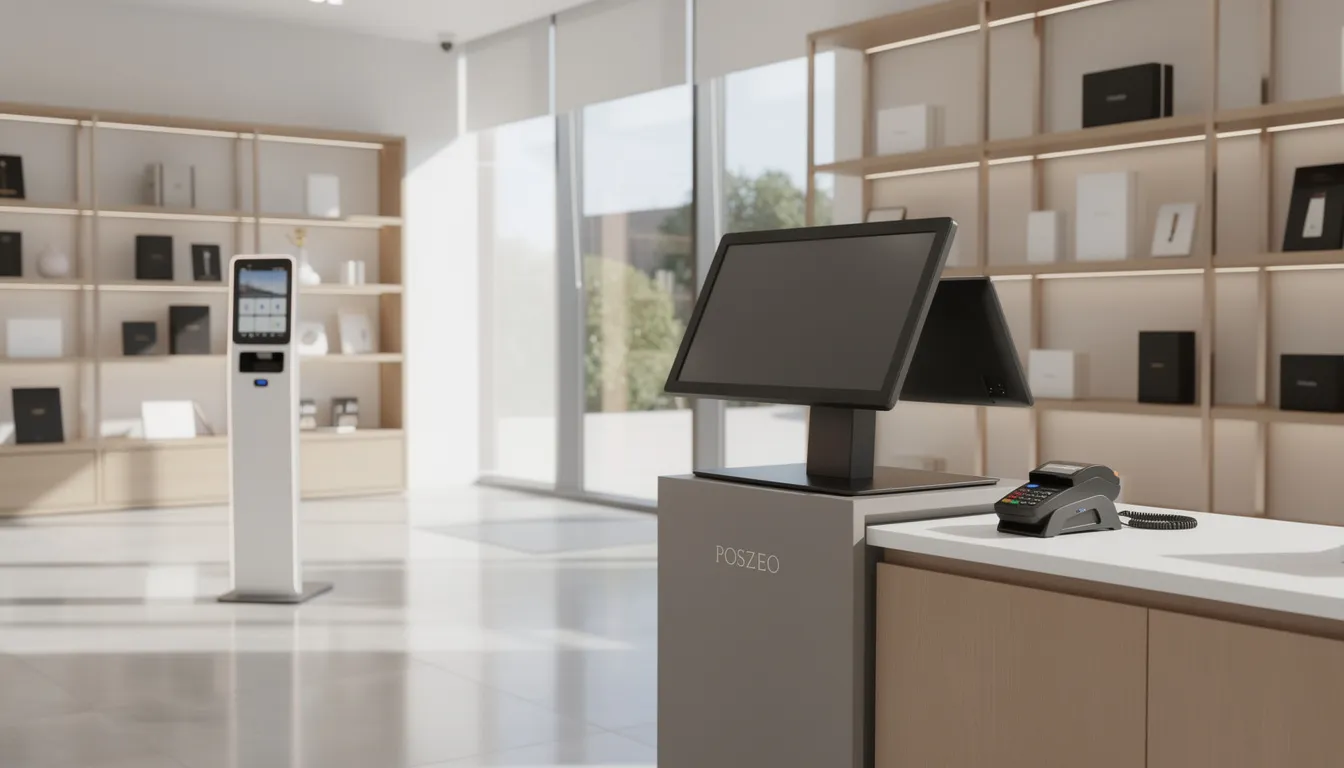
In hybrid environments, mobile devices are often Android-based portable handheld POS systems that extend checkout capacity beyond the fixed workstation.
Sometimes the best workstation decision is reducing workstation count:
- Add mobile devices for line busting
- Add kiosks for self-ordering
- Keep fixed workstations for cash, returns, and exception handling
Hybrid lanes can also expand sales channels by integrating in-store and online sales, supporting services like “buy online, pick up in-store” (BOPIS), and adding in-aisle tools such as a retail price checker kiosk for a seamless customer experience.
This is especially relevant when labor is limited, and peak traffic is predictable.
Compatibility checklist: OS, drivers, and POS software constraints
“Compatible” is not a checkbox. Compatibility is the combined behavior of OS + drivers + peripheral firmware + POS application. Choosing the right technology and a modern OS can enhance compatibility and streamline operations, ensuring your POS workstation runs efficiently with the latest hardware and software solutions.
Windows vs Android vs Linux: what changes operationally
| OS | Pros | Cons |
|---|---|---|
| Windows | Broad peripheral driver support, flexible integrations, and common in legacy environments | Driver drift after updates, background services, policy management needs |
| Android | Appliance-like behavior, simpler UI control, and often faster deployment | Peripheral support depends on vendor SDKs, OS version fragmentation, if unmanaged |
| Linux | Stability and control in certain stacks | Narrower hardware/driver choices; integrators must validate everything |
Version control: your hidden cost center
Rollouts fail when versions drift:
- Terminal OS patch changes USB device enumeration
- Printer firmware behaves differently and causes intermittent receipt issues
- Scanner settings reset after power cycles
Control plan (practical):
- Maintain a “golden build” per workstation model
- Document driver versions and firmware versions
- Schedule updates—not ad hoc updates per store
Peripheral modes and defaults (especially scanners)
Scanners can behave like keyboards (HID), serial devices, or vendor-specific modes. If you don’t standardize mode + configuration, you’ll end up troubleshooting “random” issues that are actually configuration drift.
Ports & connectivity reality: don’t lose rollouts to adapters
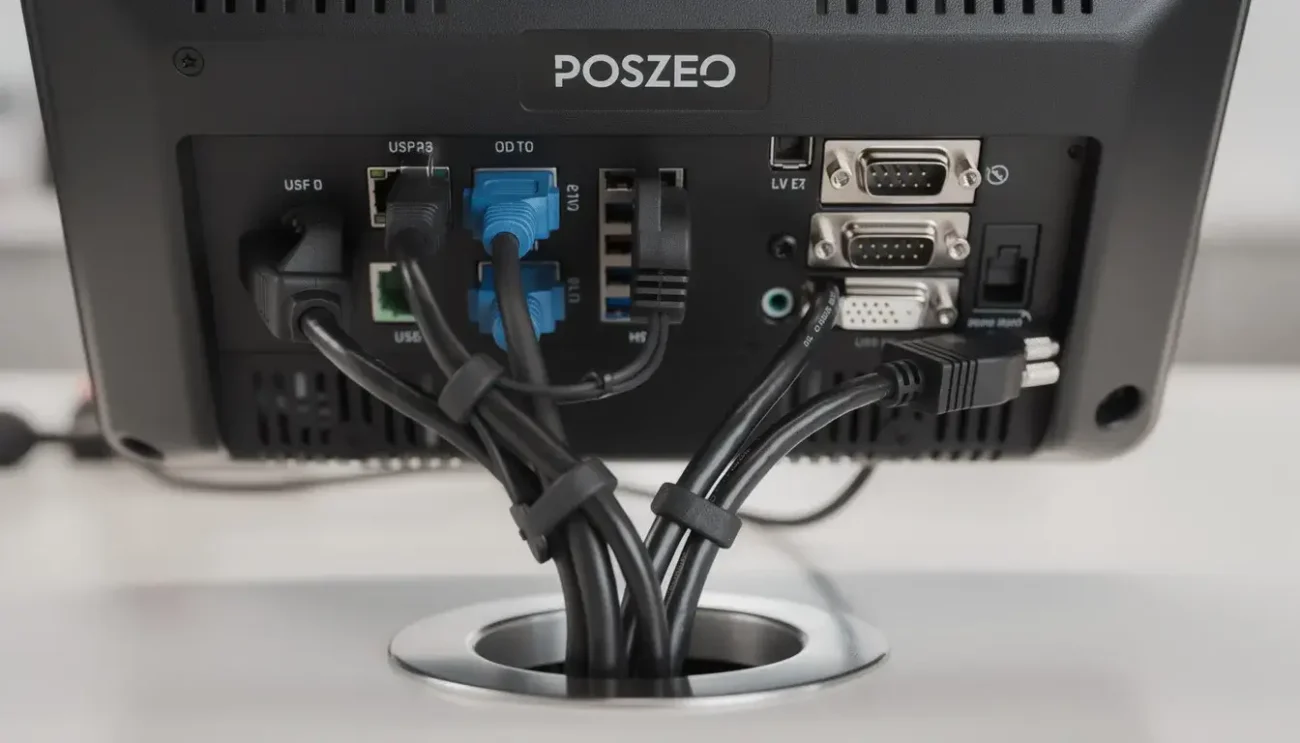
A workstation can look perfect on paper and still fail because the port plan was wrong. POS terminals connect to the internet and typically support a range of connectivity options, including USB, Ethernet, and Wi-Fi, enabling seamless deployment, management, and remote updates.
Port planning: count devices, not ports
List every device that will attach:
- Printer
- Scanner
- Customer display
- Payment terminal (or USB/serial integration cable, if applicable)
- Keyboard, mouse (in some environments)
- Optional scale, signature pad, label printer, KDS
Then add:
- One spare USB for field diagnostics
- One spare path for future additions (e.g., loyalty device, second printer)
Avoid building a workstation that depends on:
- Multiple USB hubs
- Long adapter chains (USB-to-serial-to-something else)
- Unlabeled cables (support nightmare)
Ethernet vs Wi-Fi for fixed stations
For fixed lanes, Ethernet often wins because it is:
- More stable under congestion
- Easier to isolate and segment
- Easier to test and verify during acceptance
Use Wi-Fi for:
- Temporary counters
- Pop-ups
- Backup connectivity (if your POS supports offline/queue behavior)
Cable routing and service loops (small detail, big impact)
Deployment teams should treat cabling like part of the product:
- Strain relief so ports don’t loosen
- Service loop so a tech can pull a terminal forward without unplugging
- Labeled ends so that the helpdesk can guide a store manager remotely
Payment integration impact: standalone vs semi-integrated vs integrated
Payment is where the workstation scope can explode—or stay clean. Choose the integration boundary intentionally. Payment processing is a core function of POS workstations, supporting diverse payment methods such as credit/debit cards and mobile wallets. This enables businesses to get paid in person, online, or over the phone, providing convenience for both the business and the person making the payment.
When integrating payment solutions, it’s important to understand processing fees, which are typically charged only when you make a sale. Some providers offer custom pricing for high-volume merchants, so transparency about fee structures, hardware subsidies, onboarding, and support costs is essential.
Modern POS systems streamline the process of selling products and completing purchases, allowing staff to efficiently manage sales transactions and enhancing the overall experience for both employees and customers. With integrated hardware and software, businesses can accept payments, track sales, manage inventory, and more from a single platform.
Standalone payment terminal
Meaning: payment device runs independently; POS sends totals verbally or by manual entry
Pros: simplest, least integration risk
Cons: slower, more keying errors, weaker workflow control
Semi-integrated payment
Meaning: POS triggers payment amount; terminal handles card data and returns token/approval status
Pros: better workflow, reduced keying errors, tighter process control
Cons: requires careful version control and device pairing
Integrated payment (fully integrated)
Meaning: payment is deeply embedded in the POS workflow and hardware stack
Pros: smooth UX in specific ecosystems
Cons: higher dependency risk; changes can break the whole lane
Workstation rule: The more integrated your payment is, the more you must invest in:
- Patch scheduling
- Device management
- Rollback plans
- Acceptance tests after updates
Mounting, power, and network segmentation
Payment devices add real-world constraints:
- Mounting position impacts cashier workflow and customer ergonomics
- Power requirements and cable routing can conflict with your clean install
- Network isolation matters for security and operational resilience
If your organization wants rollout discipline, tie payment behavior into your staging and acceptance tests, not into “store manager knowledge.”
Selection Matrix: how to choose the right POS workstation for your environment
Below is a procurement-ready matrix you can use to compare workstation options. Modern POS workstations streamline deployment, reduce setup time, and lower operational costs through energy-efficient designs. For example, Android POS workstations can be set up in just one minute and reduce energy consumption compared to traditional PC setups, helping businesses save on costs.
Score each 1–5 and weight by what matters for your deployment. When making your decision, consider the importance of quick setup time and streamlined workflows, as these factors can significantly reduce costs and improve deployment outcomes.
Decision criteria (what B2B teams should actually score)
- Deployability: can you install it fast with consistent outcomes?
- Peripheral compatibility: printer/scanner/drawer/display support with stable behavior
- Ports & connectivity: enough ports without hubs; Ethernet readiness
- Serviceability: swap speed, access to parts, RMA loop
- Lifecycle control: ability to manage OS/driver/firmware versions
- Scalability: how cleanly it scales to 10–100 sites
Selection Matrix (example)
| Criteria | Weight | All-in-one touchscreen workstation | Dual-screen workstation | Keyboard cash register workstation |
|---|---|---|---|---|
| Counter footprint & ergonomics | 10% | 5 | 3 | 3 |
| Peripheral stack compatibility | 20% | 4 | 4 | 4 |
| Ports & adapter risk | 15% | 4 | 4 | 4 |
| Network reliability (wired-first) | 10% | 4 | 4 | 4 |
| Payment integration flexibility | 10% | 4 | 4 | 4 |
| Serviceability (swap speed) | 15% | 4 | 3 | 4 |
| Training consistency | 10% | 4 | 4 | 5 |
| Lifecycle control (drivers/firmware) | 10% | 4 | 4 | 4 |
| How to use this: |
- If you’re a multi-location operator, overweight serviceability and lifecycle control.
- If you’re a system integrator, overweight peripheral compatibility and port/adapter risk.
- If you’re retail, overweight training, consistency, and throughput workflows.
After you score options, align them with a standardized bundle approach—similar to how multi-store teams define POS kit bundles for multi-store rollouts, so each site is a repeatable build, not a one-off project.
Deployment notes: staging, imaging, site survey, and acceptance tests
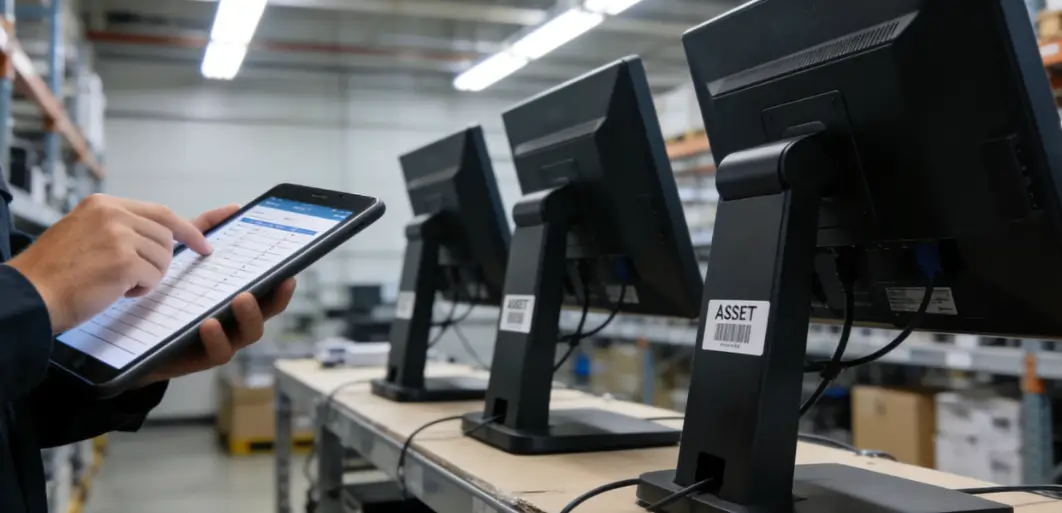
A POS workstation becomes “real” during staging and deployment. If your rollout plan is weak, hardware selection won’t save you.
Businesses can easily switch to modern POS workstations, including Android POS workstations, which streamline employee workflows and support mobility away from the workstation.
Staging
A repeatable staging process should include:
- Device labeling (asset ID, location ID, MAC address if needed)
- OS image or baseline configuration
- Peripheral pairing and configuration (scanner mode, printer settings)
- Payment device pairing (where applicable)
- A printed (or digital) quick-start sheet for store staff
If you need a rollout-friendly framework, your deployment process should look like a playbook—similar to what teams formalize around POS deployment service playbook methods: consistent steps, test scripts, and documented acceptance criteria.
Site survey
Before you finalize a workstation design, confirm:
- Counter depth and cable pass-through options
- Power outlet distance and availability
- Network drops (Ethernet) and VLAN requirements
- Peripheral placement (scanner reach, printer access, cash drawer clearance)
Acceptance test script
A workstation acceptance test should be 10–15 minutes and repeatable. Use the following steps:
- Boot and login
- Network connectivity check (wired and Wi-Fi if used)
- Test print (including cutter)
- Test scan (1D and 2D, if needed)
- Cash drawer open trigger test
- Payment transaction test (void/refund if required)
- End-of-day function test (if relevant)
- Reboot test (to ensure peripherals return to the expected state)
This acceptance script becomes your rollout “contract” between procurement, deployment, and support.
Serviceability & lifecycle: spares pool, swap model, and RMA loop
Serviceability is where workstation buyers either win long-term or bleed time and money.
What fails most often in workstation environments
Common breakpoints are rarely the CPU. They’re usually:
- Printer, cutter wear, and paper path issues
- Loose USB ports or damaged cables
- Scanner configuration drift after resets
- Cash drawer trigger failures (mismatch with printer interface)
- Power bricks and connectors
- Environmental issues: dust, spills, vibration in some environments
To reduce downtime, pair workstation standardization with an explicit maintenance plan—like a structured POS maintenance strategy that defines patch windows, health checks, and replacement rules.
Suggested spares ratio (rule-of-thumb thinking)
Exact ratios depend on transaction volume and geography, but operationally:
- Peripherals often need higher spares coverage than terminals
- A “swap first, repair later” model reduces downtime dramatically
- Keep spares staged where they can reach stores fast (regional hubs)
A practical approach:
- Define a minimum spares kit per region (printers/cutters, scanners, power adapters, cables)
- Keep at least one full workstation spare per cluster of stores (depending on criticality)
- Document the swap workflow (who authorizes, who ships, who installs)
Documentation bundle for helpdesk (what support actually needs)
Support should not rely on tribal knowledge. Provide:
- Workstation BOM + photos of correct cabling
- Port map and cable labels
- Golden image version and last patch date
- Peripheral configuration defaults
- Acceptance test checklist
- “Known good” spare part SKUs
If you also need escalation paths and a rapid triage structure, anchor your support workflow around a clear support model, such as POS technical support processes—ticketing, remote diagnostics, and version-aware troubleshooting.
Common failure modes (and how to prevent them)
Below are 8 common POS workstation failure modes that repeatedly cause rollout delays and support tickets—plus how to verify and prevent them.
Not enough ports
Symptom: intermittent disconnects, devices not recognized after reboot
Prevent: port-count based on full peripheral list + spare capacity
Verify: cold boot test with all peripherals attached; unplug/replug test
Cash drawer trigger mismatch
Symptom: drawer doesn’t open reliably; opens at the wrong time
Prevent: standardize printer model/interface and drawer trigger method
Verify: 20 consecutive open/close cycles during staging
Printer throughput/cutter issues under peak load
Symptom: jammed receipts, incomplete prints, cutter failures
Prevent: choose printers rated for your duty cycle; keep spare cutter path parts
Verify: run a peak simulation (multiple receipts in sequence)
Scanner mode drift
Symptom: scanner “types weird characters” or stops scanning into POS fields
Prevent: lock scanner configuration; document reset procedure
Verify: reboot + scan test; settings persistence test
Network instability
Symptom: random disconnects, slow authorizations, timeout errors
Prevent: wired-first for fixed lanes; define VLAN and QoS rules
Verify: connectivity check + sustained ping + transaction simulation
Payment device firmware/app version drift
Symptom: payments fail after updates; mismatched behavior across stores
Prevent: scheduled updates + rollback plan; stage updates before rollouts
Verify: test approvals/voids/refunds on a pilot workstation build
Power budget mistakes
Symptom: reboots, printer resets, random device drops
Prevent: calculate power draw; avoid overloaded strips; use strain relief
Verify: power-cycle test; wiggle test on connectors (controlled)
No spare plan
Symptom: “We can’t open lane 2 until next week.”
Prevent: spares pool + swap workflow + labeled spare kits
Verify: run a tabletop exercise: “printer failure at 7 pm—what happens next?”
Treat these failure modes as a checklist for every new workstation design. If your proposed workstation cannot pass these checks, it is not rollout-ready.
Example workstation BOMs (by store format)
These examples are not price lists. They’re deployment templates you can adapt, quote, and standardize. Leading POS workstation models offer a suite of integrated accessories and storage options, such as 256GB or 512GB solid-state drives, to meet the needs of various businesses.
For example, the Workstation 6 Series is used in Outback Steakhouse’s cloud-based technology stack, powered by Oracle Simphony Point of Sale. Simphony POS is an all-in-one restaurant management system for restaurants of any size, supporting both front-of-house and back-of-house operations. This integration streamlines restaurant workflows, from menu and order management to kitchen and back-office functions, and enables acceptance of Square payments as part of its hardware and software ecosystem. The Workstation 6 sets the bar for the industry in terms of low cost of ownership.
Standard retail lane (high repeatability)
Core device: all-in-one touchscreen POS workstation
Peripherals:
- 80mm receipt printer (LAN preferred for stability)
- 2D barcode scanner (presentation scanner for speed)
- Cash drawer (standard trigger method)
- Customer display (optional but common)
Connectivity:
- Ethernet drop at the lane
- Cable labeling + strain relief kit
Spares suggestion:
- Printer consumables and one spare printer per region
- Spare scanners and power adapters are stocked centrally
For a broader hardware stack context, see EPOS equipment and hardware stack, and ensure your workstation BOM matches the rest of your POS environment.
Convenience store compact counter (space-constrained)
Core device: compact or integrated workstation with a small footprint
Peripherals:
- 58mm or 80mm printer, depending on the receipt needs
- Handheld 2D scanner (flexible angles)
- Cash drawer (or integrated drawer workstation, depending on workflow)
Connectivity:
- Ethernet, if possible; Wi-Fi as a fallback only
Operational note: design for speed and minimal fiddling (morning peak)
Pharmacy / regulated checkout (accuracy and audit)
Core device: stable Windows or controlled Android workstation (based on software constraints)
Peripherals:
- High-reliability printer (clear receipts and labels if needed)
- Scanner (reliable 2D scanning for barcodes/QR, where applicable)
- Customer displays a way to reduce disputes
Controls:
- User roles and lockdown policies
- Repeatable end-of-day procedures
If your store format aligns with retail flows and barcode-heavy checkout, map workstation decisions to retail POS system workflows so the station design supports real operations, not just “hardware that fits.”
Buyer Checklist (Integrator-ready — copy into your RFP)
Use this checklist to qualify workstation options before you order. A key consideration is how the POS workstation enhances the experience for customers and integrates customer data to provide valuable business insights.
Procurement & compatibility
- Define the complete POS workstation system BOM (terminal + peripherals + cables + mounts)
- Confirm OS constraints: Windows POS workstation vs Android POS workstation vs Linux
- Confirm peripheral compatibility and driver/SDK requirements
- Lock versions: OS build, drivers, firmware, POS app version
Ports, power, and install
- Count devices and confirm ports (USB/LAN/Serial) with spare capacity
- Eliminate adapter chains where possible
- Confirm power budget and outlet plan
- Confirm mounting, counter footprint, cable routing, and strain relief
Payment integration
- Decide payment boundary: standalone vs semi-integrated vs integrated
- Define an update and rollback approach for payment devices
- Confirm network segmentation and security expectations
Rollout execution
- Build a staging process: labeling, imaging, configs, acceptance test
- Create a 10–15 minute acceptance test script per store
- Pilot first (1–3 sites), then scale with controlled changes only
Serviceability & lifecycle
- Define the spares pool and swap model (what can be swapped by store staff vs technician)
- Define RMA loop and documentation requirements
- Decide support ownership and escalation rules
If a workstation option cannot satisfy this checklist, it’s a high-risk choice—even if it looks great in a showroom.
Rollout Readiness Scorecard (use this before you order)
Score each workstation candidate 1–5. If you can’t score it, you haven’t validated it.
A POS workstation is a physical terminal that finalizes sales transactions in retail or hospitality environments. For rollout readiness, a POS workstation should be fully operational immediately after setup, enabling businesses to accelerate checkout and ensure accurate pricing.
| Area | Score (1–5) | What “5” looks like |
|---|---|---|
| Workstation BOM clarity | Full bundle defined, no missing parts | |
| Port & cable plan | No hubs/adapter chains; labeled cables | |
| Peripheral stability | Printer/scanner/drawer behavior is repeatable after reboot | |
| Payment integration control | Updates scheduled; rollback tested | |
| Staging & imaging | Golden build is documented and repeatable | |
| Acceptance testing | 10–15 minute script used consistently | |
| Serviceability | Swap model defined; downtime minimized | |
| Spares & RMA | Spares pool and RMA loop operational, not theoretical | |
| Version control | OS/driver/firmware drift prevented by policy | |
| Multi-site scalability | Same workstation outcome across stores |
For peripheral-heavy environments, deepen your workstation planning by reading the point of sale printer buyer guide and ensure your printer choice matches your duty cycle and support model. For payment device planning, align your mount/cable/version approach with practical integration guidance, such as the countertop payment terminal integration considerations.


Duplicate Kitchen Tickets in Multi-Printer POS: What to Check Before Replacing Hardware

POS Connectivity Issues During Peak Hours: Causes, Impact, and Solutions

POS Receipt Compliance in the US

Docked vs Roaming Handheld POS: The Real Rule for USB and Networked Accessories

POS Customer Display Ports: HDMI, USB, VGA, Serial, and USB-C Explained

Restaurant Order Routing: When a KDS Should Replace Kitchen Printers—and When It Should Not

Restaurant POS Station Map: How to Assign Terminals, Handhelds, Printers, and KDS by Zone

Android POS App Update Rollout Guide

Price-Calculating Scale vs Weight-Only Scale for POS: What Changes in Software Logic, Auditability, and Rollout Risk


